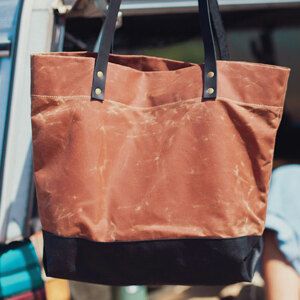
How to Reverse-Applique a Tote Bag
June 3rd, 2008 in sewing, patterns & designs, fashion, quiltingReverse-applique involves layering several fabrics together, and then cutting pieces away to reveal what's underneath. This tutorial shows you how
What you'll need:
Woven cotton fabric in three colors
Fabric pencil or marker
Sharp scissors
Small, thin sewing needle
Thread to coordinate with all three fabrics
First, choose your favorite tote pattern. Lazy Girl Designs and Hip To Piece Squares both have great patterns online.
![]() |
Stack three pieces of fabric together, right sides facing up. |
Then, when you cut fabric for the front panel of your tote, cut this same piece in three different fabrics. These three fabrics will make up the colors of your reverse-applique design. Stack these pieces on top of each other, with the right side of each one facing up.
![]() |
Pin the three layers together. |
Pin all three fabrics together, and make note of which order they're in - you'll need this information in a minute!
![]() |
Baste around all edges of the fabric stack with a large hand stitch. |
Next, baste all three layers together by hand with doubled thread. I like a large hand stitch for this step because it's so easy to remove at the end of the project. Baste your way around all edges of this stack of fabrics.
![]() |
Draw the large details of your design on the fabric. |
Draw a design for applique onto the right side of the topmost layer of fabric. You can use a fabric pencil or a water-soluble fabric marker. Start with just the largest details of your design, and make note of where you want each color to be.
![]() |
Pinch up just the topmost layer of fabric. |
Let's begin our reverse-applique by making the leaf shapes in this design, which I've decided will be pale green. The pale green fabric is the second layer of this stack of fabrics, so we'll need to cut away some of the top layer to reveal this green layer. Carefully pinch up just the top layer with your fingers.
![]() |
Snip into the top layer to begin cutting. |
Next, make a small snip with your scissors through this top layer.
![]() |
Cut away the interior of the shape. |
Then, carefully cut away the top layer of fabric, leaving about a 1/2" border inside your drawn line, as shown.
![]() |
Clip into the border, stopping at the line. |
Clip into this border with scissors, being very careful not to snip outside your drawn lines. These clips will allow you to make nice curves in your reverse-applique, so make plenty of them for the smoothest results.
![]() |
Turn the clipped edge under. |
Begin turning this clipped edge under with your fingers, so that the folded edge follows your drawn line. Press the fabric in place with your fingers. I like to turn and press just a small section at a time, and then stitch it before moving on to the next section.
![]() |
Stitch the folded edge to the fabric layer underneath. |
I like to use a small, sharp needle for reverse-applique, like a quilting needle. Stitch around the folded edge of the applique using a tiny hem stitch: take a tiny stitch into the lower layer, and then a tiny stitch into the upper layer. You may find it easiest to lay your work flat on a table as you stitch.
![]() |
Here, we begin to cut into another section of the design. |
Now let's work on an area of the design that I want to be brown. The brown fabric is the bottom-most layer in the stack of fabrics, so in order to reveal that, I'll need to cut through both the striped layer and the pale green layer. You can cut these together or one at a time - whichever way is easier for you.
![]() |
Cut away the top two layers, revealing the brown layer. |
Just pinch the two layers up as we did before, and then cut. In this case, the shape I'm appliqueing is thin line, so there's no need to cut out the center - all I need to do is make a slit down the center of the shape and clip around the edges.
![]() |
Clip, turn under, and stitch along the edge. |
Then, turn under both the upper layers together and stitch them in place.
![]() |
To add some brown detail to this green area, cut into the top layer of fabric. |
Now that we've completed the larger details, we can add some smaller ones. Let's add some brown centers to these pale green shapes. Pinch up only the pale green layer, and snip with scissors.
![]() |
When cutting a small shape, you may not need to cut out the center - just clip around the edges. |
Since we're creating a smaller shape here, we may not even need to cut out the center. Instead, we can just cut a slit and then clip the fabric out to the drawn lines.
![]() |
The more you clip the edges, the smoother your curves will be. |
When you're appliqueing smaller shapes like this, it's especially important to clip the fabric a lot so your applique will have smooth curves. See the difference between these two brown shapes? The shape on the left was clipped more than the shape on the right. See how angular the shape on the right turned out?
From this point, you can sew up your tote bag according to the pattern instructions. Once you've sewn the side and bottom seams, you can remove your hand-basting.
Now that you're comfortable with reverse applique, keep in mind that you can always use more than three fabrics, not to mention create more intricate designs. For inspiration, take a look at the fantastically detailed reverse-appliqued molas, stitched by Kuna women in Panama and Colombia.
After you make this project, show off your work to other members!
Post your project in the gallery


Comments (24)
This is the simplest and best explanation of reverse applique I have ever seen. Thank you. Finally, the mud has cleared away. Posted: 4:55 pm on April 12th
If you try this way, I hope you'll post a picture to the Gallery so we can all see! Posted: 3:22 pm on August 19th
has any one use this method on childrens clothes or patchwork Posted: 2:56 am on August 15th
I have never seen the reverse applique process, and this tutorial really makes it seem possible for me to make that really pretty tote bag. I like the reverse applique look! Thanks, Diane. Posted: 2:20 am on June 7th
And this design is beautiful! Thanks, Diane! :) Posted: 9:57 am on May 30th