How to "Fill Holes" with Buttons for a Unique Embellishment
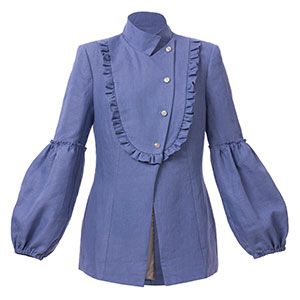
comments (4) March 7th, 2009Instead of sewing buttons on to the surface of a garment to embellish it, why not set them in, like a fine jewel? I'm talking about actually cutting holes in the fabric to create the perfect frame for a decorative button! This surprising technique is featured on an original jacket created by Gail Patrice Design. Vintage buttons with shanks made of skinny metal wire that can be easily bent to one side work great. Buttons that have a "low-profile" shank work well, too. (Just check the back of the button to see how long the shank is to make sure that it doesn't stick out too far.) Keep in mind that depending on where you position the buttons, you might get poked if the shank is too long. One more thing to keep in mind if you're working on a top is to be careful where you position the buttons so you don't create a bull's-eye!
As I searched my stash for the shank buttons so I could try this technique myself, I saw that I didn't have any that would work. So I thought about it and realized that I could "sew" thread shanks to use to fasten the buttons into the holes by simply stringing heavy topstitching thread through the holes of the button. Check it out.
What you'll need:
- A top made of medium- to heavyweight woven or knit fabric
- Soft fusible interfacing (white for light-colored fabrics or black for dark fabrics)
- Low-profile shank buttons or regular buttons that you can sew thread shanks into (see below)
- Small, sharp scissors
- All-purpose thread
- Heavy topstitching thread in colors that coordinate or contrast with your fabric
- Large-eye needle
Start by playing with the arrangement of buttons on the garment you are going to embellish. I am going to put a cluster of blue and red buttons in the lower side-front of a heavy knit tank top I'm working on. I chose three different size buttons for variety—1-1/4-inch-, 5/8-inch-, and 3/8-inch-diameter buttons. Use chalk to trace around each button so you'll know where to make your holes.
![]() |
If you are working on a light-colored fabric, use a blue wash-away marker to trace around the buttons. |
Make a paper pattern of each size button that you will be working with. You will use this pattern for two things—first to cut out the fusible interfacing, and second, to guide you when you sew the interfacing to the fabric.
![]() |
I used an index card to make my paper pattern pieces. |
Stack a few layers of interfacing and pin the pattern piece to the center of the stack. I layered three pieces of interfacing in each pile because I had three of each size button. Trim around the paper circle, allowing an extra 1/2 inch to 3/4 inch around the edge.
![]() |
The more interfacing you leave around the edge of the paper circle, the easier it will be to turn it to the wrong side and fuse in place. If your holes are close together, you might have to trim some of the interfacing so it doesn't show through a neighboring hole! |
Position a circle of interfacing, glue side up, over one of the chalk guides.
![]() |
Place one of the circular stacks of interfacing over a chalk guide. |
Sew around the paper circle.
![]() |
Use a normal stitch length like 2.5mm. With the needle in the down position, you can pivot to keep yourself on track to make a smooth circle. |
After you sew around the paper circle, trim out the center of the circle close to the stitching, leaving about a 1/8-inch seam allowance. At your ironing board, pull the interfacing through the hole to the wrong side, and start pressing it to the wrong side of the fabric. Make sure all the interfacing right at the seam is facing the back side of the hole. Work around the circle, manipulating the interfacing around the inside edge of the circle as you go.
![]() |
Pull the interfacing through the hole to the wrong side and press. |
Give the whole circle a good press when all the interfacing is in position.
![]() |
Remember to trim your threads as you go. |
![]() |
Here's how the hole looks from the right side before the button is sewn into it. |
The button should fit into the hole with a generous 1/8 inch to spare.
![]() |
This is my largest button. It's about 1-1/4 inches in diameter. |
Thread a large-eye needle with a double strand of heavyweight topstitching thread. Tie a knot and thread it through one of the holes in the center of the button. Come up from the wrong side and sew back through the second hole. Loop the thread through the double strand near the knot and pull it tight. Sew through the button holes a couple more times to create a small "thread shank" that you can use to secure the button into the hole.
![]() |
Create a thread shank sewing through the button holes several times. |
![]() |
Stitch through the thread shank and into the edge of the hole. Adjust the length of the stitch so that the button is centered. Stitch back into the shank again. |
![]() |
Take a stitch across the button to the other side of the hole. Double back to the center of the button again. Take an extra stitch to secure it. |
Repeat this process in the other direction to create a plus sign. For smaller buttons, this is enough to support the button.
![]() |
Be careful not to pull the thread too tightly, or you'll distort the circle! |
I went around and took a stitch from the shank to the end of the hole between each of the four original stitches to secure my larger buttons.
![]() |
Remember to take an extra stitch in the center to secure each leg that you are making. |
![]() |
Here is a close-up of my buttons, nestled in their holes from the right side! |


fromabove_sqs.jpg)


Comments (4)
Thank-you!
Posted: 11:52 pm on April 22nd
Posted: 9:51 am on March 14th
Posted: 2:47 am on March 11th
Posted: 8:04 am on March 7th